Wednesday, March 28, 2012

One Fish, Two Fish, Vietnamese Fish, Chinese Fish
What happened?
On Thursday March 15, 2012, 21 Vietnamese were detained for illegal fishing around islands in the South China Sea; however, the Vietnamese believe that they were fishing in their own waters and not outside of their boundaries.
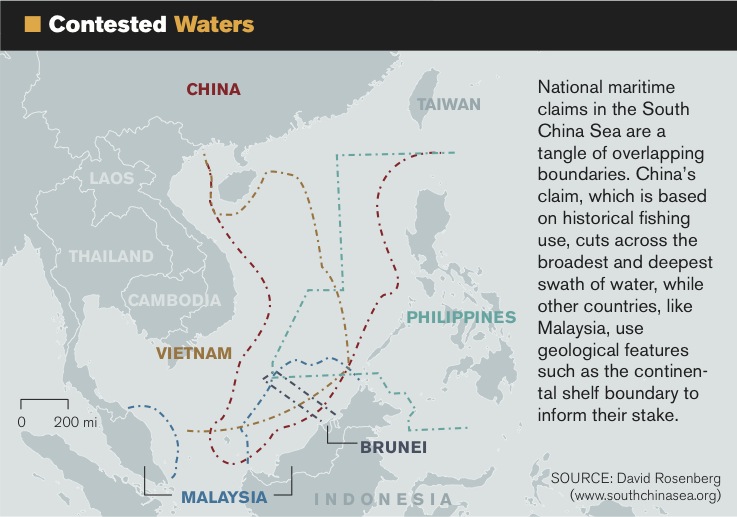
Vietnam and China both have claims in the South China Sea and to islands and reefs. Because of this, many feuds occur between fishermen as the industry is very competitive and there is profit potential.
As seen in the map below, the territory boundaries are hard to read and overlap. Because they are so vaguely defined, situations like this one will continue to rise and cause problems for the governments holding territories as well as the fishing industry. The South China Sea is an area of growing concern over conflicting territorial claims, piracy, poaching, resource depletion, pollution, drug trafficking, illegal migration, and terrorism threats.
How does China see the situation?
According to the Chinese Foreign Ministry, more than 100 Vietnamese fishing boats trespass in the Parcel Islands where they take part in illegal fishing. Because the Chinese aren’t able to keep them out of their territory, the authorities had to investigate this Vietnamese boat with the 21 fisherman and hold them to the laws so that this may serve as a warning to other trespassing fisherman and keep the Chinese in the fishing industry a market leader. With the Vietnamese fishing in the Chinese territory, they are overstepping on China’s control and maritime rights, and because of this the Vietnamese wanting to be released unconditionally most likely won’t happen.
Since the Vietnamese believe they did nothing wrong, they probably won’t take any steps to ensure that active procedures will be taken to prevent the fishermen from trespassing. Chinese authorities aren’t trying to bully Vietnam, but rather they are enforcing the law and providing a logical consequence for the illegal action. Even though it costs the Chinese money to enforce and detain the Vietnamese, they are sending a message while protecting an industry that many of its citizens actively participate in and earn an income from.
What’s the Vietnamese side of the story?
According to the Vietnamese Foreign Ministry, China violated their sovereignty. Vietnam insists that China release these 21 fishermen and their vessels. In addition to releasing their people, Vietnam also is urging China to stop detaining the Vietnamese fishermen in the waters of Vietnam.
How does a Vietnamese fisherman feel about this?
The Vietnamese Foreign Ministry issued a statement demanding the release of the fishermen whom they claimed were being held for a payment of $11,000. The Vietnamese government told the families of the fishermen to not pay while the government argues to China for their release. With this recent incident, there has been a lot of pressure put on local people, says fisherman Le Van Loc from Quang Ngai province. He had been detained by the Chinese while he was sailing near the islands in 2010. Loc says, as a Vietnamese citizen, he is angry because the islands belong to Vietnam. He says families are told not to pay the ransom while the government demands the release of those detained (Voice of America). This had made life difficult for families emotionally as well as financially.
Have there been any attempts to resolve this?
This incident is the most recent in an ongoing disagreement about territory in the South China Sea. Last year, both sides signed a series of maritime agreements in hopes of resolving tensions. However, Vietnam has continued to protest Chinese activity on or near the islands.
As stated by Reuters, “A representative from Vietnam’s Foreign Ministry met with the Chinese embassy to give them a diplomatic note outlining Vietnam’s position, and will continue the fight to resolve this matter and protect the legitimate rights of the Vietnamese fishermen.” Because the fishing industry is growing and Vietnam will go after some of China’s market share, in order to resolve this situation, more needs to be done.
A Possible Resolution
China, Vietnam, the Philippines, Malaysia, Brunei, and Taiwan all have claims to territory in the South China Sea. China’s claim is the largest, covering a big U-shape over most of the sea’s 648,000 sq. miles (Reuters). But just because China has the most, doesn’t mean it has all of it. These nations should all meet in attempt to better define borders of their territories as well as ways to police the borders. Unfortunately, China refuses to handle any disputes with more than one nation present. With one-on-one meetings, it seems that China has a “divide-and-conquer” attitude to the fishing industry.
Sunday, March 25, 2012
Monday, March 19, 2012
"Seoul Set to Combat Illegal Chinese Fishing"
The Wall Street Journal recently reported that South Korea is stepping up to the plate to combat illegal Chinese fishing by strengthening their naval defense and implementing harsher penalties among offenders of the law. This new focus for South Korea was in response to the fatal stabbing of a South Korean coastguard by a Chinese fisherman. South Korea's involvement will help reduce illicit activity that the Chinese do in international waters, such as killing sharks for shark fin soup. Read the full article here: http://online.wsj.com/article/SB10001424052970203391104577122010640638178.html
Shark Finning in China
In
China’s semi- socialist,
semi-totalitarian economy, one would think that China would have their
undesirable reputations under control and in sync with other worldly moral
views. Surprisingly, China is proud of practicing an injustice in which other
countries see as a disgusting and selfish act: The act of shark finning.
The Shark Fin Craze
Shark
finning is a brutal yet profitable “practice of global trade in which the fins
of sharks are typically hacked off a live shark” (NYTimes) only to be thrown
back into the water finless, leaving it to die slowly as it sinks to the bottom
of the sea. You may wonder what makes this brutal practice so attractive to
these Chinese fishermen? Simply put, MONEY!
Shark fins can be sold for $300 per pound. With each shark fin weighing around 1/8 of a pound, each shark fin equates to roughly $40. Further on down the trading line, shark fin soup, with only one shark fin, can be ultimately sold to the end consumer in a restaurant for a whopping $100!
Shark fins can be sold for $300 per pound. With each shark fin weighing around 1/8 of a pound, each shark fin equates to roughly $40. Further on down the trading line, shark fin soup, with only one shark fin, can be ultimately sold to the end consumer in a restaurant for a whopping $100!
If
China’s reputation is so bad, why does China refuse to regulate this
detrimental practice? Reasoning is because shark fin is a status of wealth and
a mark of tradition in China, and used as a commodity in shark fin soup. Whereas
the fins are largely tasteless, they are valued for their texture. They also
provide many benefits to its consumers as it allegedly boosts sexual potency,
enhances skin quality, increases one’s energy, prevents heart disease, and
lowers one’s cholesterol.
With China’s economy on the rise, more
affluent people can afford to purchase this symbol of a luxurious life,
directly causing the demand for shark fins to increase. This century long
tradition is profitable to the fishermen and businesses of China, further
contributing to their superior economic status. Because of this, China’s
government refuses to implement any laws that ban shark finning.

Laws Opposing Shark Finning
In
2000, the U.S. Shark Finning Prohibition Act made an effort to curtail this
practice. This law “restricts shark finning in all
federal waters... It also calls for an international effort to ban shark
finning globally. The first international ban on finning was instated in 2004
with sponsorship from the United States, the European community, Canada, Japan,
Mexico, Panama, South Africa, Trinidad and Venezuela” (TreeHugger). Notice
that this international ban does not include China, now accountable for 95% of
shark fin consumption (China.org.cn). “It is estimated that 100 to 200 million sharks annually are killed for
their fins alone” (Sharkfriends.com).
Few
countries have actually banned fining entirely, and many more need to be
encouraged to enact legislation. Even though many Asian countries oppose shark
finning, “laws can help by curbing access to the fins that
are sold. For instance, Hawaii has outlawed selling shark fin soup and California
is in the process of approving a ban on selling shark fins”(AnimalPlanet).
As a result of pressure from opposing countries, China agreed to “not land shark fins that weigh more than 5 percent of the ‘dressed’
weight of the sharks: that is, the weight of the carcass after the removal of
the head and innards” (sharksavers.org). Little by
little, more shark protections are being proposed and passed throughout the world.
The Problem
The problem in dealing with legislation is that the practice of
catching people actually finning sharks is difficult without enough law
enforcers. “Once they are instituted, enforcement of these
regulations must occur to ensure compliance” (Sharksavers.org). The Chinese government lacks adequate enforcement because the costs of
supplying these officials are outweighed by the benefits they reap from it. In
addition, bribery and corruption are common which makes it easier for these
poachers to acquire these valuable fins to trade.
“Sharks,
as predators of the sea, play a vital role in regulating the ecological
balance, particularly the health of important commercial fish species,
population balance, and protection of coral reefs” (JournalOnline). This profitable trade is blinding
China of the side effects that this practice can have to the world’s food
chain. "Shark finning is not only cruel; it is
irresponsible and unsustainable fishing at its highest degree. In spite of
this, it has been close to impossible to attain any international binding
management and conservation measures to curtail this practice” (AnimalPlanet).

WildAid
On
September 22nd, 2011, a charity program called WildAid launched a
charity campaign to persuade Chinese people to give up this delicacy. This
campaign is led by NBA star Yao Ming, who is an advocate to reduce animal
cruelty. WildAid reports that the shark fin market is estimated to have grown
around 5% per year, and this number is only going to increase as the Chinese
become more affluent. In addition, WildAid reports that 95% of all shark fin is consumed within China (WSJ). This fact proves
how oblivious and selfish China is for continuing to legalize this practice. WildAid is striving to reduce the demand for shark fin soup by educating
people. They are sponsoring public commercials in China targeted towards all
consumers, which show hidden footage of shark finning to convey the message
across to all individuals to not participate in this practice.
Potential Solution
In my opinion, Chinese people will never be persuaded to stop eating
shark fin soup without the power of the law against them. Because the Chinese government refuses to
ban this practice, I think it may be more reasonable to boycott this industry.
Many businesses, including the three largest supermarket chains of Shanghai,
have taken the initiative to take shark fins off of their shelves and menus in
hopes of creating nationwide awareness. “Meanwhile,
Chinese restaurant chain South Beauty also removed it from its menus in
November. In the U.S., Hawaii, California, Washington and Oregon have enacted
legislation that banned the trade, sale and possession of the ingredient” (WSJ).
I
think this luxurious item should have limited availability, which would indubitably
reduce the risk of shark extinction. Instead of consuming this meal regularly,
I think shark fin soup should be limited to wedding banquets and high-end
restaurants to help preserve the rare identity of this gelatinous delicacy.
“This is a peer-based practice, and therefore it is the
peer-group, not the government, that will most effectively disenfranchise the
practice” (Tyee). By enacting laws in which it is illegal for the end suppliers to
deliver shark fin soup to its customers, demand will decrease, thus reducing
the attractively of this profitable market. Hopefully legislation will prevail
in the near future before it’s too late.

Wednesday, March 14, 2012
China's Wage Hikes Ripple Across Asia
"Global companies already have been facing higher labor prices in China over the past year, despite a weak global economy, as workers demand a greater share of the country's economic boom. In recent months, the pressure also has intensified in countries across Southeast Asia that have marketed themselves as alternatives for companies seeking to escape China's rising costs, leaving those companies now with fewer places to move."
Read more at the Wall Street Journal:
Wage Hikes Ripple
Because of the wage hike, governments and companies are being forced to address worsening labor demands and income gaps, which are growing wider in many parts of the region and causing labor unrest. How do you think the Chinese government will address this?
Monday, March 12, 2012
EU and U.S. Aids in Combating Illegal Fishing
EU and U.S. Join Efforts against Illegal Fishing
Wednesday, September 7, 2011

EU Maritime Affairs and Fisheries Commissioner, Maria Damanaki, and U.S. Under Secretary of Commerce for Oceans and Atmosphere and National Oceanic and Atmospheric Administration (NOAA) Administrator, Dr. Jane Lubchenco, signed today in Washington, DC, a joint statement pledging bilateral cooperation to combat illegal, unreported and unregulated (IUU) fishing. This statement is the first of its kind in the longstanding partnership between the European Union and the United States on fisheries management.
"IUU fishing is a criminal activity, and we have the duty to make everything possible to stop this practice," said Commissioner Damanaki. "Today's agreement will do just that. By joining forces, we make it harder for culprits to get away with their dirty business."
"Illegal, unreported and unregulated fishing is one of the most serious threats to sustainable fishing and to marine biodiversity in the world's oceans," said Dr. Lubchenco. "International cooperation across oceans will help us strengthen enforcement and prevent legal fishing industries from being undermined in the global marketplace by illegal fishing."
The EU and U.S. rank first and third, respectively, as the world's top seafood importers (Japan second), and have agreed that the seafood they import will not be caught illegally. Globally, IUU fishing deprives legal fishermen and coastal communities of up to 23 billion dollars of seafood and seafood products annually.
The EU and the United States have already put in place a number of legal measures to combat IUU fishing, such as the EU's IUU Regulation and the U.S. High Seas Driftnet Fishing Moratorium Protection Act. Both participate actively in international fishery management organizations and promote international instruments to address IUU fishing.
Today's agreement commits the EU and the U.S. to work together to adopt the most effective tools to combat illegal fishing. It commits them to continue to strengthen monitoring and enforcement of management measures in their role as parties to regional fishery management organizations and to various international treaties, and commits them to using tools that prevent IUU operators from benefiting economically from their illegal activities.
The new agreement includes a system to exchange information on IUU activities; promotes management measures at regional fishery management organizations that strengthen the control, monitoring and enforcement of vessels operation within certain areas; encourages other countries to ratify and implement the United Nations Food and Agriculture Organization's Committee on Fisheries' Port State Measures Agreement; and promotes the sustainable use of fisheries resources while preserving marine biodiversity.
Beyond domestic boundaries, there is increasing need for international cooperation, especially among major fishing and seafood-importing nations, to improve global fisheries management of shared marine resources and to preserve the associated employment and other economic benefits of sustainable fisheries. The document signed today by the European Union and the United States is an important step toward achieving these goals.
Joint Statement between the European Commission and the United States Government on Efforts to Combat Illegal, Unreported and Unregulated (IUU) Fishing: http://ec.europa.eu/commission_2010-2014/damanaki/headlines/press-releases/2011/09/20110907_jointstatement_eu-us_iuu_en.pdf
Source: MarketWatch
The link to this article is: http://www.maritime-executive.com/article/eu-and-u-s-join-efforts-against-illegal-fishing
Subscribe to:
Posts (Atom)